
What Technical Feasibility Really Means in Product Planning
A guide for PMs and founders who are tired of finding out too late

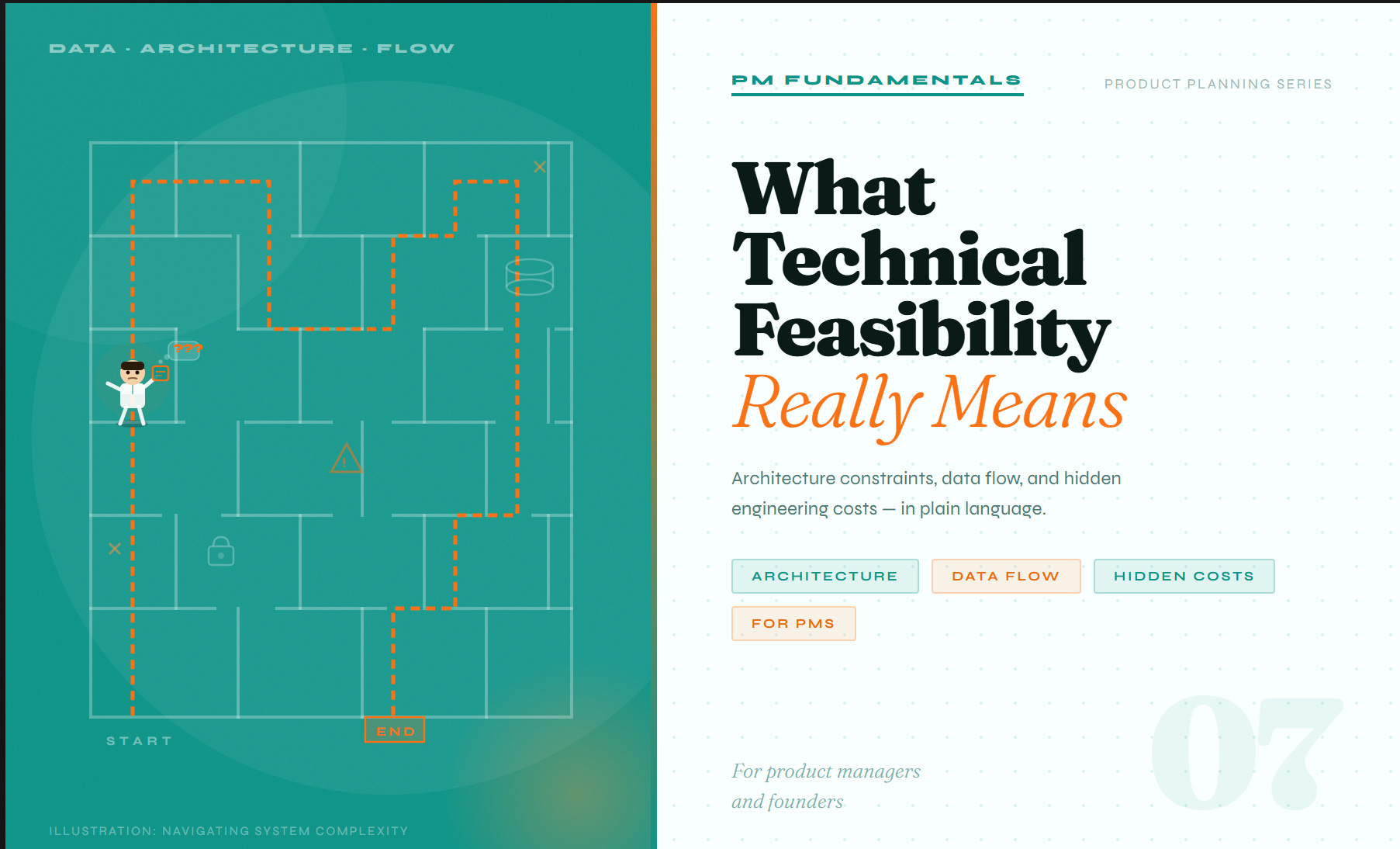
Hmmmm, so…
You walk into the sprint planning confident. The feature seems simple. “Just add a filter,” you say. “It should take a day or two.” Your engineer goes quiet for a moment, then says it will take six weeks.
This happens constantly. Not because engineers are slow. It happens because you and your engineer are looking at the same request from completely different angles. You see the user experience. They see the system underneath it.
Understanding technical feasibility does not mean you need to write code. It means you need to understand why certain things are hard. Architecture constraints. Data flow. Hidden costs. Once you see those three things clearly, your planning changes.
Architecture Constraints: What Lives Under the Surface
Every product sits on a foundation. That foundation was built by people making decisions under time pressure, with limited information, years ago. Some of those decisions were good. Some were shortcuts. All of them shape what you can build today.
Think of your product as a house. You want to knock out a wall to open up the floor plan. Sounds simple. But if that wall is load-bearing, removing it requires new beams, structural support, and permits. The same logic applies to software.
A simple toggle in your UI might require your team to rewrite the core permissions logic if the original system never accounted for role-based access. A new search filter might require rebuilding an entire data indexing layer if the current one does not support that query type.
Monolithic architectures make this worse. Many legacy products run as one large interconnected system. Change one part, and you risk breaking three others. When your engineer hesitates at a seemingly simple request, they are likely seeing a load-bearing wall you cannot see yet.
Data Flow: Where Features Actually Live
Features do not sit in one place. They pull data from multiple places, transform it, and deliver it somewhere else. The path that data travels is the data flow. When you understand it, complexity becomes visible.
Imagine you want to build a dashboard showing a user their activity history, billing status, and team permissions in one view. That sounds like one feature. But activity history lives in an event logging service. Billing lives in Stripe or a payments database. Team permissions live in a separate identity service. Your feature needs to talk to all three.
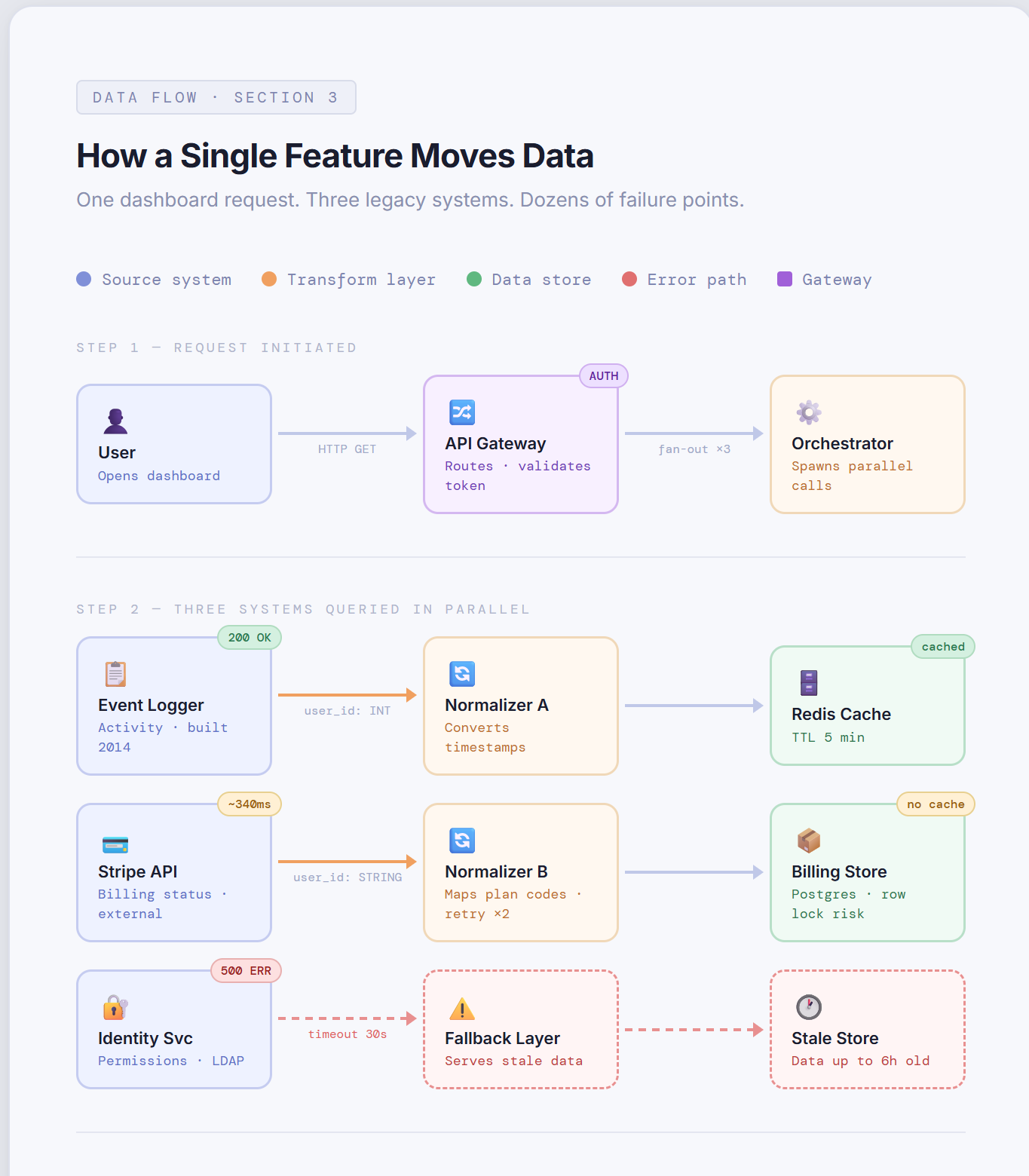
Each connection adds latency. Each system has its own schema, its own authentication, and its own failure modes. Your engineer writes three separate API calls, handles errors from each, and makes sure the combined result arrives fast enough that your user does not stare at a loading spinner.
Legacy systems make this harder. Older companies store critical data in systems built for batch processing, not real-time responses. The data exists. Getting it fast is a different problem entirely.
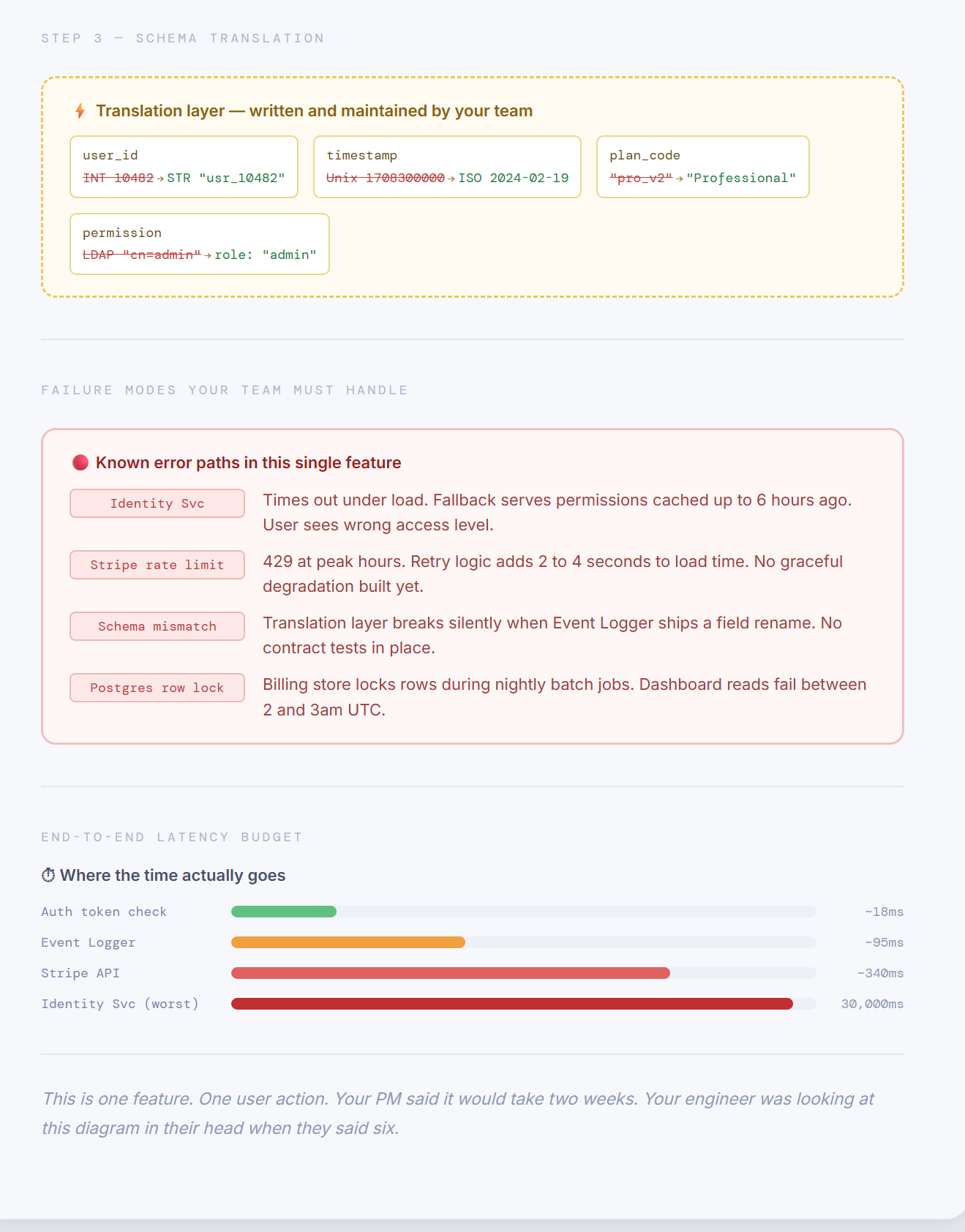
Data flow complexity multiplies when those systems are inconsistent. One service returns user IDs as integers. Another returns them as strings. Your team writes translation logic to bridge the gap. That layer needs testing, documentation, and ongoing maintenance. You probably never see any of this in a user story. That is the problem.
Hidden Engineering Costs: The Work That Does Not Show Up in Estimates
Your engineer estimates two weeks. You add a buffer and put three weeks on the roadmap. Six weeks later, the feature ships. What happened?
The visible work is the code your engineer writes. The hidden work is everything that surrounds it. Most estimates cover the visible part.
Testing is the first hidden cost. Unit tests check individual functions. Integration tests check how those functions interact with other systems. End-to-end tests simulate real user behavior across your entire stack. A feature that touches three services needs all three test layers. Writing good tests takes time. Skipping them creates debt that slows every future feature.
Security reviews add time. Any feature that touches payments, personal data, or user authentication needs a review. Someone checks for injection vulnerabilities, verifies access controls, and confirms data does not leak between accounts. This is non-negotiable work that often gets scheduled as an afterthought.
Database migrations are expensive. When a new feature requires a new data structure, your team changes the database schema. On a small database, straightforward. On a production database with millions of rows and live traffic, a migration requires careful planning, testing, and sometimes a maintenance window. Get it wrong and you corrupt data or take the product down.
Infrastructure costs are invisible until they are not. A feature that sends real-time notifications requires a different setup than one that sends a daily email digest. You need message queues, worker processes, and monitoring. Someone sets that up, tests it under load, and configures alerts when things break.
Three Questions to Ask Early
You do not need to become an engineer. You need to ask the right questions before your team starts building.
What parts of the current system does this feature touch or depend on? This reveals architectural constraints. Ask your engineer to name every service, database, or external API the feature interacts with. If they name more than two or three, expect complexity. Ask which of those systems were not designed for this kind of use. That is where your risk lives.
Where does the data come from, and how fresh does it need to be? This maps the data flow. Find out whether the data already exists in a usable format, or whether someone needs to build pipelines to collect, transform, and serve it. Ask whether real-time is truly necessary or whether a one-hour delay works. Real-time requirements multiply the cost significantly.
What work happens after the code is written? This uncovers hidden costs. Push your engineer to list everything: tests, security review, database migration, infrastructure changes, and documentation. Then ask which of those items they have not done before on your current system. Unfamiliar territory takes longer and carries more risk.
Ask all three questions in your earliest planning conversations, before your team starts scoping stories. You will get better estimates, find the real blockers, and avoid the six-week surprise.
Feasibility Is Not an Engineering Problem. It Is a Planning Problem.
Most wasted months in product development trace back to a conversation that did not happen early enough. Someone assumed the foundation would hold. Someone did not ask where the data was coming from. Someone forgot about the migration.
You do not build products by understanding every line of code. You build them by asking the right questions at the right time.
Learn to see the architecture. Trace the data. Name the hidden costs. Do this before you commit to a deadline, and you will stop shipping late, stop burning your team out, and start building things that actually land on time.
Understanding feasibility saves months. That is not an opinion. It is what separates roadmaps that work from ones that fall apart every quarter.
Great piece. Well done.